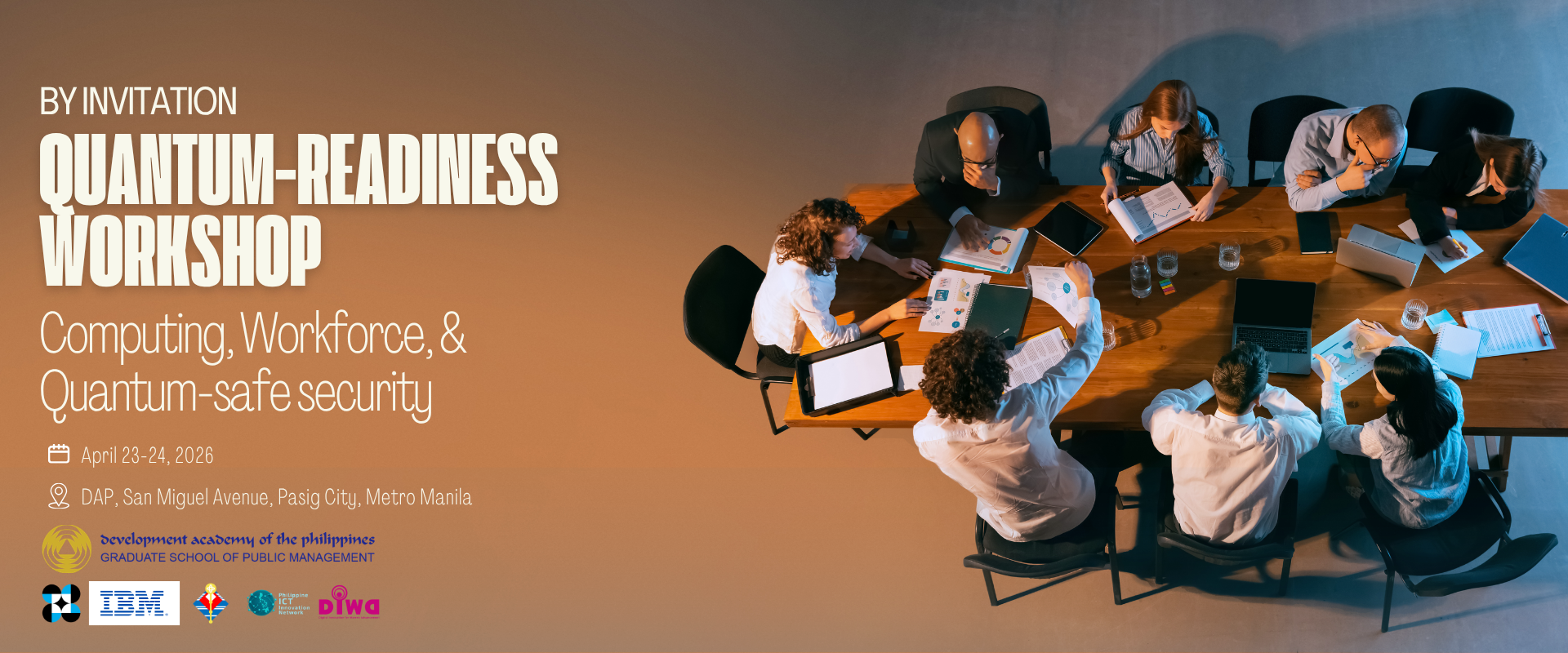
Quantum Readiness Workshop: Computing, Workforce, and Quantum-Safe Security
Keynote Speakers

Dr. Efstathia Katsigianni
IBM Quantum Safe Project Executive

Rizwan Hussain
Head of IBM Quantum Sales for APAC & Japan

Julian SK Tan
IBM Quantum – Business Development Executive (ASEAN/INDIA)

Dr. Jan-Rainer Lahmann
Distinguished Engineer within IBM's Quantum Computing team

Umut Cikla
IBM Quantum Safe Research - Executive
Event Partners
In collaboration with leading institutions and organizations


Program Flow
Day 1
April 23, 2026 - Strategy, Policy and Ecosystem Development
Registration
Opening Program
• Welcome Remarks: Dr. Leocadio Sebastian (President, DAP) • Message: Bobby Corpus, Jr. (President, QCSP) • Message: Dr. Lizan Perante-Calina (Dean, DAP GSPDM) • Keynote Message: Dr. Renato Solidum (Secretary, DOST) • Keynote Message: Henry Aguda (Secretary, DICT)
Quantum Computing Fundamentals
• Introduction to quantum computing: qubits, superposition, and entanglement • Differences between quantum and classical computing • Capabilities, limitations, and development timelines • Common misconceptions and current realities
Quantum-Safe (Post-Quantum Cryptography) Landscape Overview
• Threat landscape and critical system exposure • Global standards and regulatory directions • Government framework for quantum-safe adoption • Governance, monitoring, and enforcement considerations
Quantum-Safe Case Studies
• Lessons from real-world implementations • Outcomes, timelines, costs, and key risks
Lunch Break
Industry Implications and Priority Use Cases
• Potential applications of quantum computing • Use-case selection criteria: value, feasibility, data readiness, and workforce needs • Industry and government considerations: procurement, intellectual property, vendor risks, and evaluation metrics
IBM Quantum – Partnerships, Roadmap, and Utility
• IBM Quantum mission and partnership case studies • IBM Quantum roadmap and the “Era of Quantum Utility” • Quantum-centric supercomputing and hybrid workflows • Quantum Marketplace and government partnership models
Building a National Quantum Ecosystem
• Core elements of a national quantum initiative • Research, infrastructure access, talent, standards, and partnerships • Academe–government–industry alignment • Prioritization strategies for near-term capability building and long-term industrialization
Enabling a Quantum Workforce
• National workforce requirements • Training pipeline: foundational literacy, applied skills, and advanced research • Capability-building mechanisms, including system access, research investments, and testbeds
State of the National Quantum Science and Technology Roadmap
• Presentation of the National Quantum Science and Technology Whitepaper by Dr. Eric Galapon, Professor, National Institute of Physics, University of the Philippines-Diliman
Plenary Dialogue: Strategic Risks and National Readiness
If the Philippines does not prepare within five years, what are the implications? • Security • Economic competitiveness • Workforce readiness • Ecosystem resilience Facilitated by DOST
Day 2 Preview: From Dialogue to Immediate Action
Day 2
April 24, 2026 - Action Planning, Coordination, and Implementation
Registration
Quantum Technology Integration and Translation Roundtable
1. Security & Digital Infrastructure (DICT-led) 2. Financial & Capital Markets (BSP-led) 3. Industry & Innovation (DTI-led) 4. Critical Infrastructure (DOE-led) 5. Workforce & Education (DOST, CHED, DepEd)
Plenary Consolidation of Sector Outputs
Moderated by: DAP Each group presents: • Top three immediate actions • Assigned lead agency • Required coordination structure
Immediate Next Steps and Coordination Framework
Lead: DICT Strategic Alignment: DOST & NEDA • Baseline national quantum-safe assessment • Proposal for technical working group or steering committee • Timeline and checkpoint schedule
Closing Remarks
Closing Remarks
Lunch Break
QISKIT Hands-On Workshop
Lead: IBM • Introduction to Qiskit • Basic quantum circuits • Hybrid classical–quantum workflows
About The Workshop
The Quantum Readiness Workshop is a two-day strategic and technical forum designed to help the Philippines prepare for the next era of computing and security driven by quantum technologies.
Co-Organized By
The workshop brings together government leaders, regulators, industry executives, educators, and technical experts.
Three Interrelated Pillars
Quantum Computing and National Capability
Introducing the fundamentals of quantum computing and its realistic applications, while discussing how governments can begin building institutional awareness and long-term capability.
Workforce and Skills Readiness
Examining the skills, education pathways, and training frameworks needed to prepare public- and private-sector professionals for quantum-enabled technologies.
Quantum-Safe Security and Policy Implications
Addressing the urgent need to transition toward post-quantum cryptography and quantum-safe standards to protect government systems, financial infrastructure, and sensitive data against future cryptographic risks.
Our Approach
Rather than promoting speculative technology adoption, the workshop emphasizes practical readiness—helping institutions understand when quantum matters, where risks emerge, and how to respond responsibly through policy, governance, and capacity-building.
Our Mission
Ultimately, the Quantum Readiness Workshop aims to support informed decision-making, inter-agency coordination, and public-private collaboration so that the Philippines can anticipate, adapt to, and responsibly shape the impact of quantum technologies for national development and public good.